Air Pollution Health Risks: What 400+ Doctors Say About Poor Air Quality
Air pollution is often easiest to notice when it causes an immediate reaction — irritation, coughing, breathing discomfort or simply the feeling that the air outside is difficult to breathe.
However, the health risks associated with poor air quality may extend well beyond these immediate symptoms.
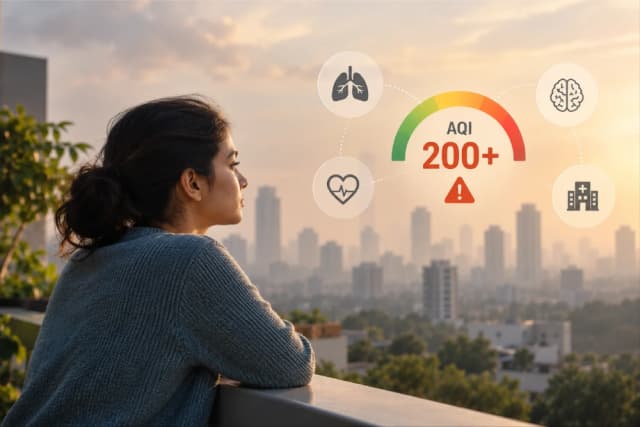
A nationwide study commissioned by TATA AIG General Insurance Company Limited, covering over 400 doctors across specialties, highlights growing concern around the potential long-term health effects of deteriorating air quality. More than 60% of doctors surveyed believe that AQI levels above 200 pose a significant health risk, while nearly three in four believe worsening air quality is contributing to an increase in long-term health risks, including respiratory and cardiac complications.
The findings indicate that conversations about air pollution and health may need to move beyond simply managing symptoms when they appear. Greater awareness, prevention, timely medical attention and financial preparedness can all form part of a more proactive approach to health.


Share this article

List of Content
 What Do Doctors Say About Air Pollution Health Risks?
- Why Is AQI Above 200 a Health Concern?
- Are People Underestimating the Effects of Poor Air Quality?
- Poor Air Quality May Affect More Than Lung Health
- Long-Term Health Risks Call for a More Proactive Approach
- The Financial Impact of Air Pollution-Related Health Emergencies
- Why Financial Preparedness Matters Alongside Preventive Healthcare
- From Managing Symptoms to Protecting Long-Term Health
What Do Doctors Say About Air Pollution Health Risks?
The study offers a useful view of how doctors across India perceive the impact of poor air quality.
Among the key findings:
More than 60% of doctors surveyed believe AQI levels above 200 pose a significant health risk.
Nearly three in four believe deteriorating air quality is contributing to an increase in long-term health risks, including respiratory and cardiac complications.
Two-thirds believe patients underestimate the impact of prolonged exposure to poor air quality.
78% say high AQI levels can worsen existing chronic conditions, including hypertension, cardiovascular disease, stroke and diabetes.
These findings suggest that the effects of poor air quality should not be viewed only through the lens of temporary discomfort.
For many people, the more important question may be what repeated or prolonged exposure could mean for health over time.
Why Is AQI Above 200 a Health Concern?
The Air Quality Index, or AQI, is commonly used to indicate the level of air pollution in a particular location.
According to the TATA AIG study, over 60% of the doctors surveyed believe AQI levels above 200 represent a significant health risk. What makes this finding particularly relevant is that poor air quality can easily become part of everyday life. When elevated pollution levels persist, people may become accustomed to them, particularly when they are not experiencing an immediate health problem.
However, the doctors surveyed indicate that poor air quality should not necessarily be dismissed simply because its effects are not always immediately visible.
That makes awareness an important part of protecting long-term health.
Are People Underestimating the Effects of Poor Air Quality?
One of the strongest findings from the study concerns the difference between medical concern and public perception.
Two-thirds of doctors surveyed believe patients underestimate the impact of prolonged exposure to poor air quality.
There is an important reason why this may happen.
A visible health emergency demands attention. Prolonged exposure to poor air quality may not.
If someone does not experience an immediate or severe reaction, it can be easy to assume that the health impact is limited. But the study suggests doctors are concerned about risks that can extend beyond short-term symptoms.
This makes lung health and air quality an issue that may require ongoing awareness rather than attention only when breathing problems occur.
Poor Air Quality May Affect More Than Lung Health
Air pollution is naturally associated with respiratory health, but the doctors surveyed raised concerns that extend beyond the lungs.
Nearly three in four doctors surveyed believe deteriorating air quality is contributing to an increase in long-term health risks, including respiratory and cardiac complications.
The study also found that 78% of doctors believe high AQI levels can worsen existing chronic conditions, including:
Hypertension
Cardiovascular disease
Stroke
Diabetes
For people already managing chronic health conditions, this finding adds another dimension to the conversation around poor air quality.
It suggests that air quality should not be viewed purely as a respiratory-health issue. Instead, doctors see it as part of a broader health conversation, particularly where existing conditions are concerned.
Long-Term Health Risks Call for a More Proactive Approach
Many health decisions are naturally reactive.
We experience symptoms. We seek medical attention. We receive treatment.
The findings of the TATA AIG study point towards the importance of complementing this approach with greater preparedness.
As Dr. Santosh Puri, Head – Retail Health & Travel Underwriting, Tata AIG General Insurance, noted while commenting on the findings, lung health is often something people think about only once they experience a respiratory problem.
The study instead points towards a broader approach built around four areas:
Awareness. Prevention. Timely medical care. Financial preparedness.
These elements serve different purposes, but together they can help individuals and families think about health risks before an emergency occurs.
The Financial Impact of Air Pollution-Related Health Emergencies
The health consequences of a serious illness are only one part of the challenge.
Emergency hospitalisation, ICU care and prolonged treatment can also create substantial financial pressure for individuals and families.
The TATA AIG study highlights a significant preparedness gap.
A majority of doctors surveyed indicated that close to 95% of patients are financially unprepared to manage the costs of emergency hospitalisation or ICU care arising from severe AQI-related illnesses.
This finding should be interpreted carefully. It represents the assessment of doctors participating in the study regarding their patients; it is not a separate measurement showing that 95% of India's population is financially unprepared.
Nevertheless, it highlights an important aspect of health preparedness that can sometimes receive less attention.
Preparing for health risks does not only mean trying to prevent illness. It can also mean considering whether an unexpected hospitalisation could place significant pressure on household finances.
Why Financial Preparedness Matters Alongside Preventive Healthcare
Preventive healthcare and financial protection serve different roles.
Financial preparedness cannot prevent poor air quality or replace appropriate medical attention. Similarly, preventive steps cannot completely eliminate the possibility of an unexpected health event.
The two therefore need not be viewed as alternatives.
Being prepared financially can help individuals and families manage the financial burden associated with unforeseen hospitalisation and treatment, while preventive healthcare, awareness and timely medical attention address the health side of the equation.
This is why the study points towards a more holistic way of thinking about protection.
Health preparedness can include taking steps before illness occurs rather than responding only after a medical emergency has already developed.
From Managing Symptoms to Protecting Long-Term Health
World Lung Day is an opportunity to focus attention on respiratory health, but the findings from more than 400 doctors suggest that lung health deserves consideration throughout the year.
The numbers tell an important story.
More than 60% of doctors surveyed believe AQI above 200 poses a significant health risk.
Nearly three in four believe deteriorating air quality is increasing long-term health risks.
Two-thirds believe patients underestimate the effects of prolonged exposure.
And 78% believe high AQI can worsen existing chronic conditions.
Taken together, the findings point towards a change in how we think about air pollution and health.
The question is not only:
“What should I do when poor air quality makes me feel unwell?”
It may also be worth asking:
“How prepared am I for health risks that may not be immediately visible?”
Protecting health is not only about treating symptoms when they appear. Greater awareness, prevention, timely care and financial preparedness can all contribute to a more proactive approach to long-term health.
Frequently Asked Questions About Air Pollution and Health Risks
Can poor air quality have long-term health effects?

Nearly three in four doctors surveyed in the TATA AIG study believe deteriorating air quality is contributing to an increase in long-term health risks, including respiratory and cardiac complications.
Is AQI above 200 considered a health risk?
More than 60% of doctors surveyed in the study believe AQI levels above 200 pose a significant health risk
Can high AQI affect people with existing health conditions?
According to the study, 78% of doctors surveyed believe high AQI levels can worsen existing chronic conditions, including hypertension, cardiovascular disease, stroke and diabetes
Do people underestimate the impact of poor air quality?
Two-thirds of doctors participating in the study believe patients underestimate the impact of prolonged exposure to poor air quality
Why is financial preparedness important when considering health risks?
Serious health events can involve emergency hospitalisation, ICU care or prolonged treatment. A majority of doctors surveyed indicated that close to 95% of patients are financially unprepared to manage the costs of emergency hospitalisation or ICU care arising from severe AQI-related illnesses. Financial preparedness can therefore complement preventive healthcare by helping individuals and families manage unexpected healthcare expenses.
Read More
Share this article
Latest from our blogs

What Does Health Insurance Cover in India?
Learn what health insurance covers, including hospitalization, treatments, surgeries, and medical care.
Read More
Does Health Insurance Cover Malaria Treatment?
Learn how health insurance can help cover malaria-related medical expenses, treatment, and hospitalization.
Read More
Inpatient vs Outpatient Hospitalisation Explained
Compare in-patient and out-patient hospitalization, including costs, treatment scope, and insurance coverage
Read More"Disclaimer: The content of this article is for general informational purposes only and is subject to change. It is based on information available at the time of writing.
Any insurance-related information given above cannot be interpreted as policy coverage. It should not be considered insurance, medical, legal, regulatory, or other professional advice, or a substitute for the terms and conditions of your health insurance policy.
Health insurance coverage, benefits, exclusions, limits, eligibility criteria, and other applicable conditions are subject to the terms of the respective policy document. Please refer to the applicable policy document for complete details. Readers are advised to verify the latest information with the relevant authorities or official sources before making any decisions.
Any reference to health insurance or TATA AIG is for general awareness only and does not constitute an offer, recommendation, or advice to purchase a health insurance policy from TATA AIG. TATA AIG does not guarantee coverage for any specific claim, medical expense, loss, or situation based solely on the information provided in this article."