Understanding Construction Health and Safety Signs and Significance
Construction sites are among the most hazardous work environments in the world, and managing that risk starts with clear and compliant safety signage. Every sign displayed on your site carries a specific message, whether it warns workers of nearby dangers, enforces mandatory safety requirements, or guides people to emergency equipment.
Getting this right is not simply a matter of good practice, as it is also a legal obligation. This guide walks you through everything your business needs to know about construction safety symbols and meanings behind each colour and shape, as well as the responsibilities you hold as a site operator.
Understanding the importance of safety in construction helps you take the most straightforward steps to build a safer, better-managed construction site.


Share this article

Explore TATA AIG’s Workmen Compensation Insurance Solutions and Offer Your Workforce Comprehensive Protection!
 Premium calculator(Requires manual entry. Mobile Number not required)
List of Content
 What are Construction Health and Safety Signs?
- What are the Different Types of Site Safety Signage?
- What Do the Colours Mean on Construction Safety Signs?
- Why Are Construction Safety Signs Important?
- How Construction Safety Signs Help Prevent Accidents?
- Strategies for Optimising Safety Signage in Construction Sites
- Conclusion
What are Construction Health and Safety Signs?
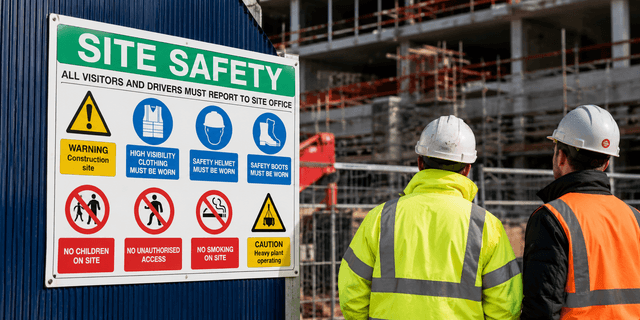
Construction health signs and construction safety signs are visual indicators placed across work sites to communicate critical safety information to all personnel. Each sign carries a specific and potentially life-saving message, from hazard warnings to mandatory protective equipment requirements, and should never be treated as a mere formality.
Failing to recognise or follow these signs can result in serious accidents or even fatalities. All site safety signage must comply with the applicable National Health and Safety Regulations. Site staff are required to undergo proper training and hold the necessary qualifications to correctly interpret and act on every sign encountered on-site.
What are the Different Types of Site Safety Signage?
Warning Signs: Construction warning signs are designed to alert both workers and the public to potential hazards present on a construction site. Their purpose is to ensure that everyone in the vicinity is aware of nearby risks so they can act cautiously and take the appropriate precautions before proceeding.
These signs are typically triangular in shape, with a bold yellow background and a black symbol at the centre, a combination that makes them highly visible and easy to interpret at a glance.
These construction warning signs can commonly be seen in situations like:
- Presence of asbestos
- Overhead high-voltage cables
- Highly flammable gases
- Hazardous chemicals
- Wet or slippery floors
Purpose: To warn people about potential risks so they can stay careful and take the right precautions.
Mandatory Signs: Mandatory signs communicate actions that all site personnel must follow without exception. Unlike prohibition signs, which restrict certain behaviours, mandatory signs provide clear, direct instructions that must be adhered to to maintain a safe working environment.
These mandatory construction safety signs are easily recognisable by their distinctive blue circular background with a white symbol or text at the centre, making them simple to identify on busy, fast-paced construction sites.
Common examples include:
- Wearing a hard hat at all times
- Using high-visibility PPE
- Wearing safety glasses, gloves, and ear protection
- Using a safety harness when required
Purpose: To ensure workers follow essential safety practices and use the right protective equipment at all times.
Prohibition Signs: Prohibition signs are used to clearly communicate actions that are strictly forbidden on a construction site. These construction safety signs feature a bold red circle with a diagonal cross-line running over a black symbol on a white background, making them instantly recognisable even from a distance.
The combination of colour and imagery leaves no room for misinterpretation, ensuring that both workers and visitors understand exactly what is not permitted in a given area. These signs tell people what they must not do, such as “No Smoking” or “No Entry.”
Workers can commonly see them in places such as:
- Restricted areas where entry is not allowed
- Areas with set speed limits
- No smoking zones
- Spots where parking is not permitted
Purpose: To stop behaviours that could lead to accidents or safety risks, ensuring a safer work environment for everyone.
Safe Condition Signs: Safe condition signs guide people to safety, whether during the normal flow of daily site operations or in an emergency. Rather than highlighting dangers, these emergency safety signs point people in the right direction, showing them where to find safe areas, emergency exits, and essential safety equipment when they need it most.
They are always displayed in green with white text or construction site safety symbols. They are typically rectangular in shape, making them instantly recognisable and easy to follow even in stressful or high-pressure situations.
Common examples include:
- Fire exit routes
- Assembly or meeting points
- Push the bar to open the doors
- First-aid kits or safety kits
- AED locations
- Emergency showers
Purpose: To direct people quickly to safe areas, exits, or essential safety equipment when needed.
Fire Equipment Signs: Fire equipment signs are specifically designed to help workers and visitors quickly locate fire-fighting equipment on a construction site. In the event of a fire, every second counts, and these construction safety signs ensure that no time is wasted searching for the nearest extinguisher or alarm point.
They feature a bold red background with white construction site safety symbols or text, and are square or rectangular. While the red colour may initially draw comparisons to prohibition signs, the distinct shape and imagery make them easy to tell apart, even in an emergency situation.
These site safety signages can be found near:
- Fire hydrants
- Fire extinguishers
- Fire alarm call points
- Fire blankets
Purpose: To help people quickly locate fire-fighting equipment and take the right action during a fire emergency.
What Do the Colours Mean on Construction Safety Signs?
Safety symbols and meanings should be easy to understand at a glance, and colours play a crucial role in this clarity. By properly identifying the colours, workers can figure out what is going on and what they should do, even from a distance.
Here is a detailed guide on what each of these colours mean:
Red (Circular Panel): This means something is not allowed. It is used to stop actions that could be risky, like going into restricted areas or smoking where it is unsafe.
Yellow Panel: Yellow signs are there to warn the workers. These workplace hazard signs indicate potential dangers, such as slippery floors, electrical hazards, or harmful materials, so workers can stay alert.
Blue Panel: Blue signs tell workers what they must do. They will usually see them reminding them to wear safety gear, such as helmets, gloves, or boots.
Green Panel: Green signs guide workers to safety. They show where to find things like emergency exits, first-aid kits, and safe routes during an emergency.
Red (Rectangular Panel): These signs help workers quickly locate fire equipment such as extinguishers, alarms, and hydrants when needed.
Why Are Construction Safety Signs Important?
The importance of safety signs should never be underestimated, regardless of a worker's experience. Here are some of the most important reasons why these signs are essential:
Prevents Accidents and Injuries: Construction safety signs warn of dangers such as falling objects, slippery floors, electrical hazards, and restricted areas. When people pay attention to them, they can avoid unsafe situations and reduce the risk of injury.
Ensures Compliance With Regulations: There are strict safety rules that every construction site must follow. Signs help make these rules clear by showing what’s allowed, what’s not, and where to go in case of an emergency. Ignoring them can lead to fines or legal trouble.
Improves Awareness and Preparedness: Clear construction safety signs help workers stay aware of what’s happening around them. They also make it easier to act quickly during emergencies by showing where to find items such as fire equipment, assembly points, and safety gear.
Supports Smooth Movement and Guidance: Safety signs also help keep things organised. They guide movement, mark restricted areas, and indicate safe routes, making it easier for everyone to move around the site.
How Construction Safety Signs Help Prevent Accidents?
Site safety signage serves as a constant visual reminder, helping everyone understand the risks around them and take the right steps to stay safe, even in the busiest conditions. Here are a few ways safety signs help prevent accidents:
Alert People to Hazards: Safety signs indicate dangers such as high-voltage areas, slippery surfaces, or falling objects. This helps workers and visitors stay alert and avoid unsafe situations.
Give Clear Instructions: Some tasks need strict safety rules. These workplace hazard signs remind people to wear helmets, goggles, gloves, or other protective gear, especially in hazardous areas.
Show Where Safety Equipment Is: In an emergency, every second matters. Signs help people quickly locate items such as first-aid kits, fire extinguishers, sprinklers, and eye-wash stations.
Encourage a Safety-First Mindset: Regularly seeing these signs keeps safety top of mind. It reminds everyone to follow the right practices and look out for each other.
Keep Awareness High: Construction safety signs constantly highlight risks and precautions, helping people stay alert throughout the day.
Support Compliance with Rules: They also help ensure the site is in compliance with safety regulations by clearly outlining what needs to be done and what should be avoided.
Also Read: Most Important Construction Safety Issues
Strategies for Optimising Safety Signage in Construction Sites
Conduct a Thorough Risk Assessment: Before any site safety signage is installed, a thorough risk assessment should be conducted to identify all potential hazards across the site. This ensures that the right signs end up in the right places, addressing each specific risk rather than taking a generic approach that may leave certain dangers overlooked.
Carry Out Regular Maintenance and Updates: Construction safety signs can deteriorate over time due to weather, general wear, and constantly changing site conditions. Inspecting signage regularly and replacing anything that is damaged, faded, or no longer relevant should never be put off. After all, a sign that cannot be read clearly serves very little purpose.
Involve Workers in the Process: The people working on-site every day have the clearest sense of where the real risks lie and where signage is most needed. Bringing workers into the conversation when selecting and positioning safety signs leads to better decisions and encourages greater ownership and compliance across the whole team.
Leverage Technology Where Appropriate: In areas with poor visibility or high noise levels, traditional construction safety signs alone may not always convey the message. Digital displays and illuminated signs can make a real difference in these challenging environments. This ensures that important safety information is always visible and clearly understood by everyone.
Also Read: Tips to Improve Construction Site Safety
Conclusion
A well-signed construction site reflects a business that takes safety seriously. But true responsibility goes beyond the construction safety signs on the walls. It extends to ensuring that every worker who steps onto your site is protected, not just physically, but financially too.
TATA AIG's workmen compensation is built for businesses that understand the weight of that responsibility. Our comprehensive WC policy covers medical treatment, lost wages, and rehabilitation for workers injured on the job, relieving both the employer and the employee of the financial burden during an already difficult time.
As a trusted provider of commercial insurance across India, TATA AIG stands out for its construction-specific expertise, flexible coverage options, and dedicated claims team.
Workers' compensation insurance is more than a policy. It is a promise to your workforce that their well-being comes first.
Explore TATA AIG’s Workmen Compensation Insurance Solutions and Offer Your Workforce Comprehensive Protection!
Premium calculator(Requires manual entry. Mobile Number not required)Frequently Asked Questions
How do workers understand safety signs on-site?

Site safety signage is only useful if people actually understand it. That is why it is important for employers to explain what each sign means through simple training sessions, toolbox talks, or regular reminders. When workers know what to look for, they can react quickly and safely.
How often should safety signs be checked?
It is a good idea to regularly check safety signs. Over time, they can get damaged, faded, or covered in dust. Making sure they are clean and clearly visible helps keep everyone alert and safe.
When should Construction safety signs be used?
Construction safety signs should be used whenever a risk cannot be completely removed. They serve as quick warnings or instructions, whether highlighting a danger, reminding workers to wear protective gear, or showing the safest way out in an emergency.
People also search for
 labour insurance policyworkmen compensation policy premium calculatorgroup medical insurancegroup health insurance premium calculatorPI Insuranceprofessional indemnity for lawyersPI Insurance for Doctorsprofessional indemnity insurance for chartered accountantscompany secretary indemnity insuranceprofessional indemnity insurance for interior designersprofessional indemnity insurance for teachersprofessional indemnity insurance for it companiesEngineering InsuranceContractors Plant Machinery InsuranceErection All Risk InsuranceContractors All Risk PolicyLiability Insurance CoverageCyber Insurance
Key Insurance term
Marine Cargo InsuranceMarine Transit Insurancemarine insurance premium calculatormarine sales turnover policyOpen Marine Insurance PolicyMarine Freight InsuranceFire And Burglary Insuranceshopkeepers insuranceBurglary Insurance Policyfire insurance policyOffice Insurance PolicyTheft Insurance Policycommercial property insuranceStandard Fire and Special Perils PolicyShare this article
Latest from our blogs
How Safety Boosts Employee Health Explained
Learn how strong industrial safety practices directly improve overall employee health for smarter decisions.
Read More
Excavation Safety for Construction Explained
Understand why excavation safety is critical for construction sites and how to manage the risk before you buy.
Read More
Health Cover When Changing Jobs Explained
Learn what happens to your corporate health insurance when you switch jobs or employers for smarter decisions.
Read More"Disclaimer: The content of this article is for general informational purposes only and is subject to change. It is based on information available at the time of writing.
Any insurance-related information given above cannot be interpreted as policy coverage. It should not be considered insurance, legal, regulatory, or other professional advice, or a substitute for the terms and conditions of your workmen compensation insurance policy.
Workmen compensation insurance coverage, benefits, exclusions, limits, eligibility criteria, and other applicable conditions are subject to the terms of the respective policy document. Please refer to the applicable policy document for complete details. Readers are advised to verify the latest information with the relevant authorities or official sources before making any decisions.
Any reference to workmen compensation insurance or TATA AIG is for general awareness only and does not constitute an offer, recommendation, or advice to purchase a workmen compensation insurance policy from TATA AIG. TATA AIG does not guarantee coverage for any specific claim, compensation, loss, liability, or situation based solely on the information provided in this article."